Agentic CAD Platforms vs AI Image Generators: Which One Builds Real Jewelry
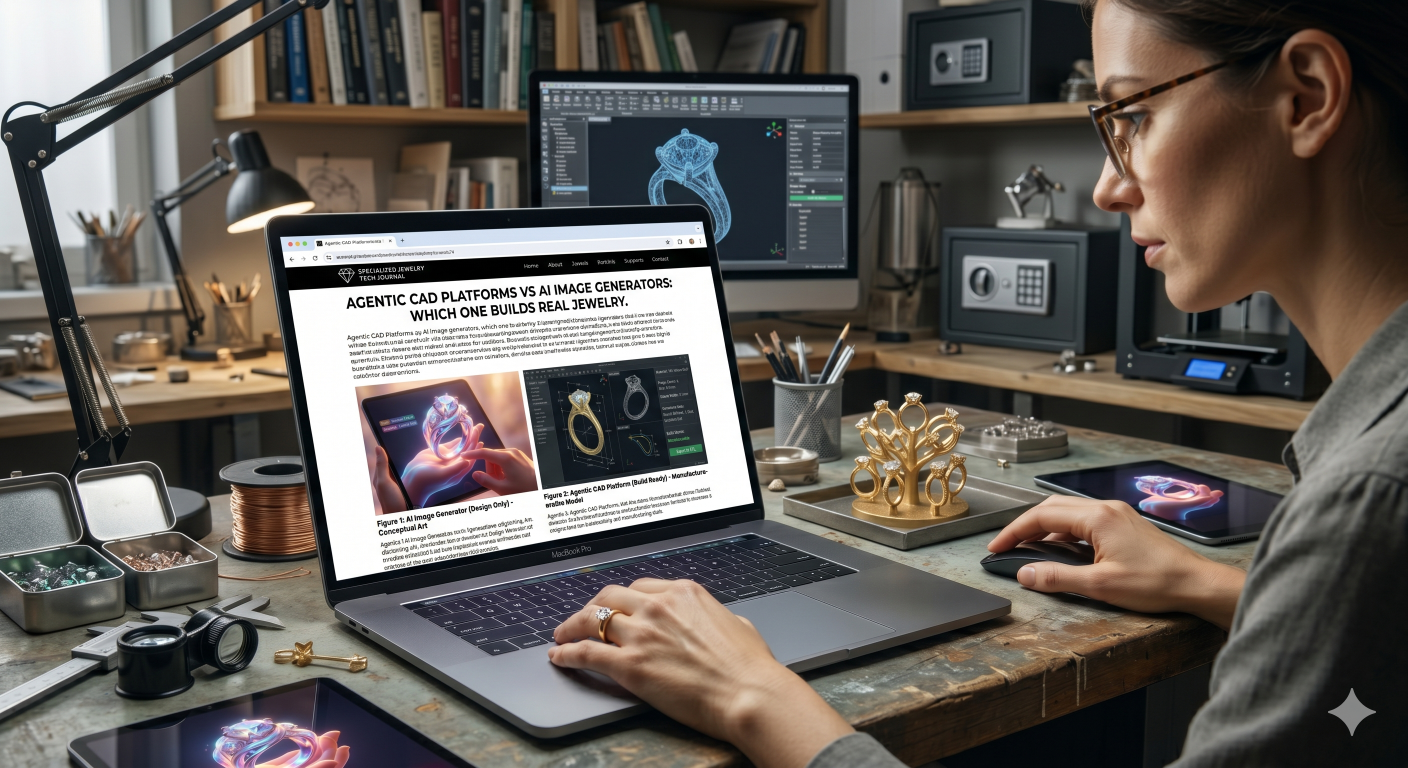
AI image generators create stunning jewelry visuals, but you can't manufacture a PNG file. The gap between a beautiful picture and a production-ready design is where most jewelry projects stall, and where the distinction between generative AI and agentic parametric CAD becomes critical.
This article breaks down how each technology works, what they can and can't do, and which one actually gets jewelry made.
What is an AI image generator for jewelry design
The difference between an agentic parametric platform and an AI image generator comes down to one thing: engineering a manufacturable product versus creating a 2D picture. Tools like Midjourney, DALL-E, Facet Flow and BLNG AI produce pixel-based visuals from text prompts. They're essentially digital artists that understand visual patterns but have no concept of physical constraints, precise measurements, or manufacturing requirements.
When you type "a solitaire engagement ring with a 1-carat round diamond" into an AI image generator, you'll get a beautiful image. But that image contains no actual data about the ring's dimensions, the exact stone size, or whether the prong placement would physically hold a gem. The output is a flat file—a PNG or JPG—with no depth, no volume, and no geometry that a manufacturer could use.
AI image generators fall under the category of generative AI, meaning they reactively produce content based on your input. They don't plan, reason about constraints, or take autonomous action toward a goal. They simply generate one image at a time, and if you ask for changes, they create an entirely new image rather than modifying the existing one.
What is an agentic parametric CAD platform
An agentic parametric CAD platform combines two concepts that, together, change how jewelry gets made. "Parametric" means every element of a design—band width, stone diameter, prong height—is controlled by adjustable numerical parameters that maintain mathematical relationships with each other. "Agentic" refers to AI that autonomously takes goal-directed actions, like understanding that a stone requires prongs and automatically generating them to fit the specified gem size.
When you design a ring on an agentic parametric platform, you're not getting a picture. You're getting real geometry that can be exported as an STL, STEP, or 3DM file and sent directly to a 3D printer or casting house.
Pencil is currently the only platform in the jewelry industry that operates this way. It functions as an autonomous expert designer that understands physical constraints, material properties, and manufacturing requirements—while remaining accessible to users without CAD experience.
How parametric geometry powers manufacturable jewelry CAD
Parametric modeling defines every curve, angle, and dimension through exact numerical values. A band width isn't just "thin" or "thick"—it's precisely 2.5mm. A stone setting isn't approximately round—it's mathematically calculated to fit a 6.5mm brilliant cut.
The real power emerges when parameters connect to each other. Change the ring size from 6 to 7, and the entire model updates automatically while maintaining proper proportions. Swap a 1-carat stone for a 1.5-carat, and the prongs, setting height, and head dimensions all adjust to accommodate the new specifications.
This interconnected precision is what makes files production-ready. A caster or 3D printer doesn't interpret artistic intent—they require exact coordinates, verified tolerances, and watertight geometry. Parametric systems deliver exactly that.
Key differences between agentic CAD and AI image generators
Understanding the differences between agentic CAD and AI image generators helps clarify which tool serves which purpose in a jewelry workflow.
FeatureAI Image GeneratorAgentic Parametric CADOutput type2D image (pixels)3D CAD file (geometry)Geometric precisionNoneExact to fractions of mmStone sizingApproximate visualPrecise carat/mm specsManufacturabilityCannot produceProduction-ready filesDesign iterationNew image each timeParameter adjustments
Geometric precision and control
When you type "2mm band" into an AI image generator, the resulting image might show something that looks like a 2mm band—or it might not. There's no actual measurement encoded in the output, and the same prompt will produce visually different results each time.
Parametric CAD defines that band as exactly 2.00mm, and you can verify the measurement before production. If you want 2.2mm instead, you adjust one parameter and the entire model updates predictably.
Stone sizing and setting accuracy
Jewelry manufacturing depends on precise stone specifications. A 6.5mm round brilliant requires a setting engineered to those exact dimensions—the prongs, bezel, or channel all have to mathematically accommodate that specific stone.
AI generators have no concept of calibrated stone sizes. They create visual representations that might look like a 6.5mm stone, but there's no underlying data ensuring the setting would actually hold one. Parametric platforms calculate the geometry to guarantee proper fit.
Manufacturable file output
An AI-generated image cannot be manufactured directly. To produce a physical piece from that image, someone with CAD expertise would have to manually recreate the design in traditional software—a process that can take hours or days and introduces interpretation errors.
Agentic parametric platforms skip this step entirely. The design you create is already a manufacturable file, ready for export in industry-standard formats that casters and 3D printers accept directly.
Iteration and repeatability
Regenerating an AI image produces entirely different results. Even with the same prompt, you'll get variations in proportions, angles, and details. Controlled refinement becomes nearly impossible.
Parametric models allow surgical precision in changes. You can adjust the prong height by 0.3mm while keeping everything else identical, or widen the band without affecting the head design. This repeatability is essential for production consistency.
Cost and time to production
AI images add an intermediary step—and significant cost—before manufacturing. The image has to be interpreted and rebuilt in CAD software by a skilled designer, which can cost hundreds of dollars and take days.
Agentic parametric platforms eliminate this bottleneck. Design flows directly to production files, reducing both timeline and expense while maintaining accuracy.
Why precise stone sizes and ring sizing require real geometry
Jewelry tolerances are measured in fractions of millimeters. A ring size difference between 6 and 6.5 is roughly 0.8mm in diameter—a distinction that's invisible in an image but critical for wearability.
Stone settings are even more demanding. Consider what happens when measurements are off:
- Undersized setting: A prong designed for a 6.5mm stone won't properly secure a 6.3mm stone, leaving the gem loose and vulnerable to loss.
- Oversized stone: Forcing a 6.7mm stone into a 6.5mm setting risks cracking the gem or bending the metalwork.
- Incorrect depth: A bezel that's too shallow won't protect the girdle; too deep, and it obscures the stone's brilliance.
AI-generated images simply cannot encode this precision. They show what jewelry might look like, not how it would actually function as a wearable, manufacturable object.
Use cases for AI image generators in jewelry
AI image generators aren't without purpose—they serve specific roles in the early stages of design.
Mood boards and concept exploration
When exploring aesthetic directions or communicating initial ideas to clients, AI images can quickly visualize styles without committing to detailed CAD work. They're useful for answering "what if" questions about general appearance before investing in production-ready designs.
A designer might generate dozens of variations in minutes to narrow down a direction with a client. The images won't be manufacturable, but they can spark conversation and alignment on style preferences.
Marketing imagery and visual inspiration
For social media content, lookbooks, or artistic renderings where precision doesn't matter, AI generators can produce compelling visuals efficiently. A jewelry brand might use AI-generated lifestyle images for Instagram or Pinterest, where the goal is aesthetic appeal rather than technical accuracy.
The key distinction: AI images work well for inspiration and marketing, just not for manufacturing.
Use cases for agentic parametric CAD platforms
When the goal is producing actual jewelry, parametric precision becomes essential.
Custom engagement rings and fine jewelry
One-of-a-kind pieces require specific finger sizes, exact stone specifications, and accurate metal weights for pricing. Every custom order involves geometry that matches the customer's requirements precisely—there's no room for approximation when someone is buying a ring they'll wear for decades.
Made-to-order and configurator-driven stores
Brands offering customer customization—choose your stone, select your metal, specify your size—require systems that dynamically generate correct CAD files for each unique combination. A customer selecting a 7mm cushion cut in rose gold at size 8 expects a file that reflects exactly those specifications, not a generic template that requires manual adjustment.
Production-ready files for casting and 3D printing
Any piece intended for physical production requires exportable geometry. Whether you're working with a local caster or a manufacturing partner overseas, they require files—not pictures. The file format matters too: STL for 3D printing, STEP for CAD interchange, 3DM for further editing in Rhino.
Building real sellable jewelry with Pencil
Pencil brings agentic parametric design to jewelry creators without requiring CAD expertise. The platform handles the technical complexity automatically, allowing designers to focus on creative decisions while generating production-ready files.
With over five million customization options and direct connections to manufacturing partners, Pencil transforms the traditional jewelry workflow. You can design a piece, generate lifelike product images from the actual 3D model, and connect with manufacturers—all from one platform that understands both creative vision and manufacturing reality.
Frequently asked questions about agentic CAD and AI image generators
Can you 3D print or cast a ring from an AI-generated image?
No. AI images contain only pixels without underlying geometry, so they require manual recreation in CAD software before any physical production is possible. A skilled CAD designer would have to interpret the image and rebuild the design from scratch, adding time and cost to the process.
Are AI image generators considered agentic AI?
No. Most AI image generators are generative AI that reactively produces content from prompts. Agentic AI autonomously takes goal-directed actions—like building parametric geometry that satisfies manufacturing constraints—rather than simply generating output from input. The distinction matters because agentic systems can reason about requirements and adapt their output accordingly.
Why can't AI image generators produce the same result for identical prompts?
Image generators create new compositions each time rather than modifying existing ones. Every generation is a fresh interpretation of the prompt, which makes controlled iteration impossible and results inherently unpredictable. If you love 90% of an AI-generated ring image but want to change the band width, you can't—you have to regenerate entirely and hope for something similar.
What file formats does an agentic parametric CAD platform export?
Platforms like Pencil export industry-standard formats including STL for 3D printing, STEP for CAD interchange, and 3DM for further editing in tools like Rhino. Manufacturers universally accept these formats, which means designs can move directly from platform to production without conversion issues.
Do you need CAD experience to use an agentic parametric platform like Pencil?
No. Agentic parametric platforms handle the technical CAD work automatically, allowing users to design through intuitive controls rather than manual modeling. The system manages geometric relationships and manufacturing constraints behind the scenes, so you can focus on design decisions rather than software commands.
Can AI image generators calculate metal weight or provide jewelry pricing?
No. Without real geometry, AI images cannot determine volume, weight, or material costs. Only parametric CAD with actual dimensions can provide accurate production estimates. If you're quoting a customer or managing inventory, you require real numbers—and those numbers come from real geometry, not pixels.