Why Image-Based AI Pricing Estimators Fail: The CAD Advantage in 2026
A photo of a ring can tell you what it looks like. It cannot tell you what it weighs, what alloy it's made from, or how much skilled labor goes into producing it—which is exactly the information manufacturers use to calculate costs.
Image-based AI pricing tools promise quick estimates from photographs, but they're working with fundamentally incomplete data. Below, we'll examine why these tools fail, how inaccurate estimates damage jewelry businesses, and why CAD files remain the only reliable foundation for production pricing.
Why image-based AI pricing estimators fail for jewelry
Image-based AI pricing estimators are tools that analyze photographs of jewelry to generate production cost estimates. They work by using pattern recognition to identify visual characteristics—ring shape, apparent stone size, general style—and then match those characteristics against pricing databases. The appeal is obvious: snap a photo, get a price. But here's the problem: images simply cannot contain the data that manufacturers actually use to calculate costs.
When a jewelry manufacturer prices a piece, they're working with specific numbers. Exact metal volume in cubic millimeters. Precise alloy composition. Stone quality grades verified by gemological laboratories. Band thickness down to fractions of a millimeter. None of this information exists in a photograph, no matter how high the resolution or how many angles you capture.
The result is what data scientists call "garbage in, garbage out." An AI analyzing an image is essentially making educated guesses based on what a piece looks like, not what it actually is. A photograph of a gold ring cannot tell you whether it's 10k, 14k, or 18k gold. It cannot reveal whether the center stone is a VS1 or SI2 diamond. And it certainly cannot account for the hidden structural elements—internal supports, setting mechanisms, or specialized finishing requirements—that significantly affect production costs.
Platforms like BLNG AI and Facet Flow market pricing from the designs they generate, but the fundamental limitation remains. For jewelry businesses, treating image-based estimates as reliable quotes introduces real financial risk. You might quote a customer $1,500 based on an image estimate, then discover the actual production cost is $2,000 once a manufacturer reviews the real specifications.
Common myths about AI jewelry pricing tools
Several misconceptions lead jewelry businesses to place more trust in image-based tools than the technology warrants. Let's look at where each assumption breaks down.
More product photos mean better estimates
The intuition makes sense: more data equals better results, right? Not in this case. Adding multiple angles or higher-resolution images gives the AI more surface information, but surface information isn't what determines production costs. Ten photos of a ring still cannot reveal the precise metal weight, the exact stone specifications, or the fabrication complexity. You're feeding the system more of the wrong kind of data.
AI can accurately assess gemstone value from images
Stone quality grades—the characteristics that dramatically affect pricing—require laboratory certification and often physical inspection. Color grades involve comparing stones against master sets under controlled lighting. Clarity grades require magnification to identify inclusions. Cut grades involve precise measurements of angles and proportions.
A VS1 diamond and an SI1 diamond can look nearly identical in photographs, yet the price difference might be hundreds or thousands of dollars. No amount of image analysis can reliably distinguish between grades that trained gemologists assess using specialized equipment.
Image estimators track metal market fluctuations
Gold prices change daily. Platinum prices fluctuate based on industrial demand. Silver moves with broader commodity markets. An accurate jewelry quote reflects current material costs at the time of production.
Photo-based tools typically pull from static pricing databases rather than live commodity feeds. Even if the visual analysis were perfect, the material costs could be outdated by the time you receive the estimate. CAD-based systems, by contrast, can integrate directly with real-time pricing data because they know the exact material volume required.
Visual analysis understands custom fabrication costs
Some pieces require hand-finishing that adds hours of skilled labor. Others need custom casting techniques or specialized tooling. Certain designs demand multiple production stages with quality checks between each step.
None of this complexity is visible in a photograph. A ring that looks simple might require intricate fabrication processes, while an ornate-looking piece might actually be straightforward to produce. Visual appearance and manufacturing complexity don't correlate reliably.
How inaccurate pricing estimates hurt jewelry businesses
Pricing errors don't stay contained to individual transactions. Over time, they compound and affect business health in ways that aren't immediately obvious.
Eroded profit margins on custom orders
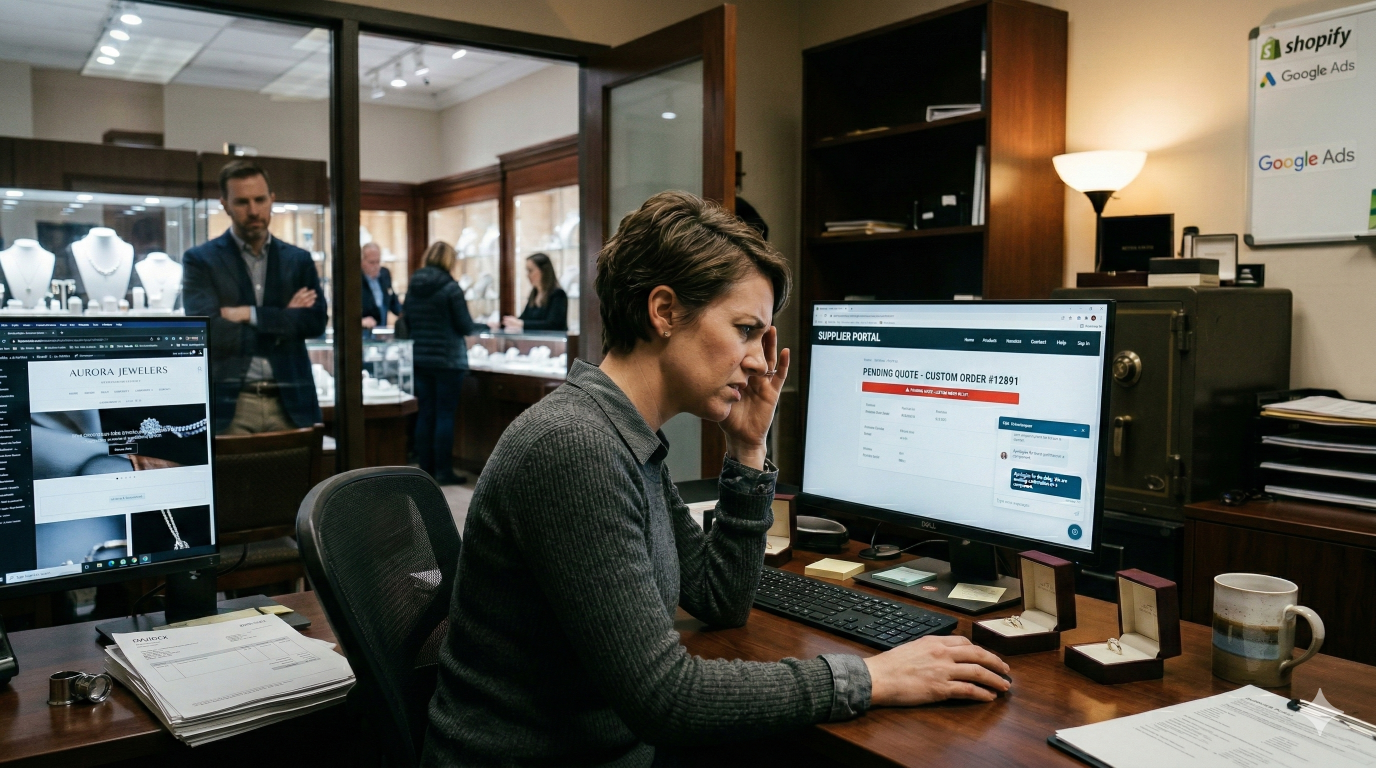
When estimates come in low, you face an uncomfortable choice: honor the original quote and lose money, or revise the price and risk losing the customer. Custom orders are particularly vulnerable because they often involve unique specifications that image-based tools handle poorly.
If your estimate misses by 20% on a $2,000 piece, that's $400 in lost margin—assuming you decide to honor the quote. Across dozens of orders, those losses add up quickly.
Customer disputes from unexpected price changes
Customers who receive a second, higher quote often feel misled, even when the adjustment reflects accurate production costs. The conversation shifts from excitement about their custom piece to frustration about pricing. Some customers walk away entirely. Others complete the purchase but leave with a negative impression that affects future business and referrals.
Wasted time requoting production jobs
Each revision cycle adds days to your timeline. You send specifications to a manufacturer, receive a quote that doesn't match your estimate, go back to the customer with updated pricing, wait for approval, then restart the production process. Meanwhile, other orders stack up and design work gets pushed aside.
Damaged manufacturer relationships
Manufacturers who consistently receive unrealistic pricing expectations learn to protect themselves. They might add buffer pricing to your quotes, deprioritize your orders during busy periods, or eventually decline to work with you altogether. Professional relationships depend on accurate communication, and repeated pricing mismatches erode trust on both sides.
Why CAD-based pricing is more accurate than image analysis
CAD stands for computer-aided design—software that creates precise three-dimensional digital models. Unlike photographs, CAD files define exact geometry: every curve, every dimension, every specification in mathematical terms that translate directly to manufacturing requirements.
The difference is fundamental. An image represents appearance. A CAD file represents reality.
When a manufacturer opens a production-ready CAD file, they can extract exact metal volume down to the cubic millimeter. They can identify every stone setting, count every prong, and measure band thickness precisely. They can assess fabrication complexity based on actual geometry rather than visual interpretation.
This isn't a matter of AI sophistication. Even the most advanced image analysis cannot extract information that doesn't exist in the source data. A CAD file contains production specifications by design. A photograph, by definition, does not.
How CAD files enable accurate jewelry pricing
CAD files serve as the single source of truth for production specifications. Everything a manufacturer requires to calculate costs exists within the file itself.
Precise material volume calculations
CAD software calculates exact metal volume and weight automatically based on the three-dimensional model. The geometry defines the material requirements mathematically—there's no estimation involved.
For a simple band, the software calculates the volume of the ring shape minus any hollow areas. For complex pieces with multiple components, it sums the volume of each element. The result is a precise number that, combined with current material prices and the specific alloy density, yields accurate material costs.
Built-in manufacturing specifications
Production-ready CAD files include more than just shape. They contain stone settings with exact dimensions, prong counts and positions, band thickness measurements, and technical requirements for finishing. When you send a CAD file to a manufacturer, all of this information travels with the design.
The manufacturer doesn't have to guess about specifications or make assumptions based on visual appearance. The file tells them exactly what they're building, which means they can tell you exactly what it costs.
Best practices for getting accurate jewelry pricing
A few practical approaches can dramatically improve pricing accuracy and reduce friction between design and production.
1. Start with a CAD file
Accurate pricing requires a real 3D CAD file. If you're working from sketches, reference images, or verbal descriptions, the first step is translating that concept into production-ready geometry. Until a design exists as precise specifications, any price is just an estimate.
This used to mean hiring a CAD specialist or learning complex software. Today, platforms like Pencil allow anyone to create production-ready CAD files without prior experience—but regardless of which tool you use, the principle remains: CAD first, then pricing.
2. Use Pencil's live quote tool
Pencil includes an integrated quoting tool that generates pricing directly from your CAD designs. Because the platform connects to verified manufacturers, you receive real production costs rather than estimates.
The process works like this: you design a piece using Pencil's tools, select your materials and specifications, and the platform calculates pricing based on actual manufacturer rates. Often, you'll have accurate pricing within minutes of completing your design.
How to choose the right jewelry pricing tool
When evaluating pricing tools, several criteria separate reliable solutions from those that introduce risk:
- CAD file support: The tool accepts standard production file formats (STL, OBJ, 3DM) rather than relying solely on images
- Manufacturer network integration: Direct connections to verified manufacturers provide real production costs, not algorithmic estimates
- Real-time material pricing: Metal costs fluctuate daily, so the tool reflects current commodity rates
- Custom-driven design compatibility: The platform handles unique, made-to-order pieces, not just standard catalog items
- Production-ready output: Designs are manufacturable without additional conversion or modification
The common thread is data quality. Tools that work from precise specifications produce accurate pricing. Tools that work from visual approximations produce estimates—and estimates carry risk.
Why CAD-first design is the path to reliable jewelry pricing
Starting with production-ready CAD files eliminates the guesswork that plagues image-based estimation. When your design exists as precise geometry rather than a photograph, manufacturers can provide binding quotes based on actual specifications.
The workflow shift is significant. Instead of designing visually and then scrambling to figure out production costs, you design with production in mind from the start. Pricing becomes part of the creative process rather than an afterthought that might derail your plans.
Platforms like Pencil make this approach accessible to designers without CAD backgrounds. You can create production-ready files, connect directly with manufacturers, and receive accurate quotes—all without learning complex software or hiring specialists. The traditional barriers between design and production pricing simply don't apply anymore.
FAQs about AI jewelry pricing estimators
Can AI image estimators provide accurate pricing for simple jewelry pieces?
Even basic designs require precise material weight and quality specifications that images cannot capture. A simple band still involves exact dimensions, specific alloy composition, and finishing requirements. The complexity of the design doesn't change the fundamental limitation: photographs don't contain production data.
What CAD file formats do jewelry manufacturers accept for pricing?
Most manufacturers accept standard formats including STL, OBJ, and 3DM files. Production-ready files with embedded specifications—like those generated by Pencil—typically provide the most accurate quotes because they include all necessary manufacturing details in a format manufacturers can work with directly.
How long does it typically take to receive pricing from a CAD file?
Manufacturers can often provide accurate quotes within hours when working from production-ready CAD files. This compares favorably to the days of back-and-forth communication typically required when estimating from images, where clarifying questions and specification requests extend the timeline.
Do jewelry designers need CAD experience to get accurate production pricing?
Not anymore. Platforms like Pencil enable anyone to create production-ready CAD files without prior software experience. The learning curve that once made CAD inaccessible to many designers has largely disappeared with modern, intuitive design tools.
How do jewelry manufacturers calculate production costs from CAD files?
Manufacturers extract precise material volume, weight, and specifications directly from CAD geometry. They then apply current material rates based on the specific alloy, add labor costs based on fabrication complexity, and include finishing requirements. The result is a quote based on actual production requirements rather than visual estimates.