Ruby Kinglet vs Pencil
Ruby Kinglet is an AI image and photo tool that says it can also export CAD. Pencil is parametric CAD that you can open and test today.
The difference is between a claim on a web page and a design you can measure, price and cast.
Ruby Kinglet sells an AI workbench for jewelers. Most of it produces pictures: AI design images, edited product photos and AI photoshoots.
Its site also describes CAD export but we looked for evidence of that CAD. We found no demo, no sample file, no named customer and no review. We did find Ruby Kinglet's own caveats about what its files cannot do.
Ruby Kinglet and Pencil comparison
| Ruby Kinglet | Pencil |
|---|
| What it mainly produces | AI images, product photos and renders | Parametric CAD models |
|---|
| Public proof | No demo, sample file, named customer or review that we could find | 100,000+ designers and hundreds of live stores |
|---|
| What shoppers see on your site | Pre-rendered photos or an AI render | Live 3D of the actual design |
|---|
| Price shown to shoppers | A custom design arrives as a quote request | The exact price, calculated from the design |
|---|
| Before casting | Bench review, and a CAD jeweler for the hard part, by its own account | The production file is ready |
|---|
| Leads, CRM and analytics | Quote requests | Lead capture, an API to your CRM and a full analytics platform |
|---|
Ruby Kinglet is mostly an image tool
Ruby Kinglet describes four parts: design, product photoshoots, CAD and storefront customizers. Three of the four make pictures.
Its design tool assembles a piece from components and outputs an image. Its AI Studio offers more than 20 image editing tasks. Its photoshoots generate product photos and video.
An image has no geometry. It has no band width, no stone seat and no metal weight, so it cannot be priced exactly and it cannot be cast. That is true of every AI image tool, whatever it is called.
The CAD claims come with no proof
Ruby Kinglet's site says its CAD engine is "Rhino-backed" and exports STL, OBJ, GLB and editable 3DM. Those are specific claims. They are also the only evidence offered.
We read its homepage, its CAD articles and its Shopify builder page. None of them links to a demo you can try, a sample file you can download or a video of the CAD being edited.
None names a customer, shows a testimonial or presents a case study. Its site says more than 3,000 jewelers use the platform, and Capterra lists it with no reviews.
CAD is easy to prove. You publish a file, and a jeweler opens it. Pencil features multiple examples on its public website of the final manufacturing-ready CAD STL.
If you are evaluating Ruby Kinglet, ask for three things before you pay: a 3DM file from a design you choose, a live store that uses its builder, and a jeweler who has cast from its output.
Ruby Kinglet's own example of a generated CAD file
The CAD section of Ruby Kinglet's homepage has a few screenshots and no file you can open. The example it uses for generating an STL shows two things side by side. On the left is a render of a gold ring with a pink center stone and an engraved bezel. On the right is the 3D model made from it.
Look at the model closely. It is a single-color mesh, and the center stone appears to be part of the same solid as the metal. There is no separate stone and no visible seat for one. The engraving that surrounds the stone in the render does not appear on the model.
A ring is cast in metal, and the stones are set afterwards. A casting model has an empty seat where each stone will go. Cast a model with the stone fused into the head and you get metal where the stone should be.
Someone has to remove the stone, cut the seat and rebuild the prongs before it can be made, and that someone is a CAD jeweler.
This is what an image-to-mesh tool produces. It copies the outside shape of a picture. It does not know that the ring is metal and the stone is not.
Ruby Kinglet's own caveats
Ruby Kinglet's articles are candid about the limits, and they matter more than the headline claims.
The AI path makes a mesh. A mesh is a surface. You cannot change a prong or a ring size in it the way you can in parametric CAD.
Complex pieces still need a CAD jeweler. Ruby Kinglet says micro-pave, multi-stone clusters and unusual settings can look right on screen and fail to cast, and that a CAD jeweler may need to finish "the last 10 to 20%".
A bench jeweler should review the file before casting. That is Ruby Kinglet's own advice.
So the CAD work has not gone away. For anything beyond a standard piece, you pay for the subscription and for the CAD jeweler.
On your website, shoppers get a render and a quote
Ruby Kinglet's storefront customizer has three modes: pre-rendered options, a live preview, and full custom design. In the custom mode, the shopper designs a piece, watches the AI render it, and sends it to you as a quote request.
That is the same problem as any image-based builder. The shopper approves a picture, and then waits for you to work out the price. Quote delays are where custom sales are lost.
In Pencil, the shopper changes a real CAD model in live 3D. The price is calculated from that model and updates with every change. They can buy on the spot, and the production file is ready when they do.
What Ruby Kinglet says about Pencil
Ruby Kinglet's comparison articles describe Pencil as an AI tool that outputs an STL mesh that cannot be edited by part. That is wrong.
Pencil is parametric CAD. Every design is a model with editable parameters, including prong diameter, bezel wall thickness, crown height, band width and ring size. Changing one updates the rest of the piece.
STL is one of the formats you can export from that model. It is not what the design is made of.
What Pencil does instead
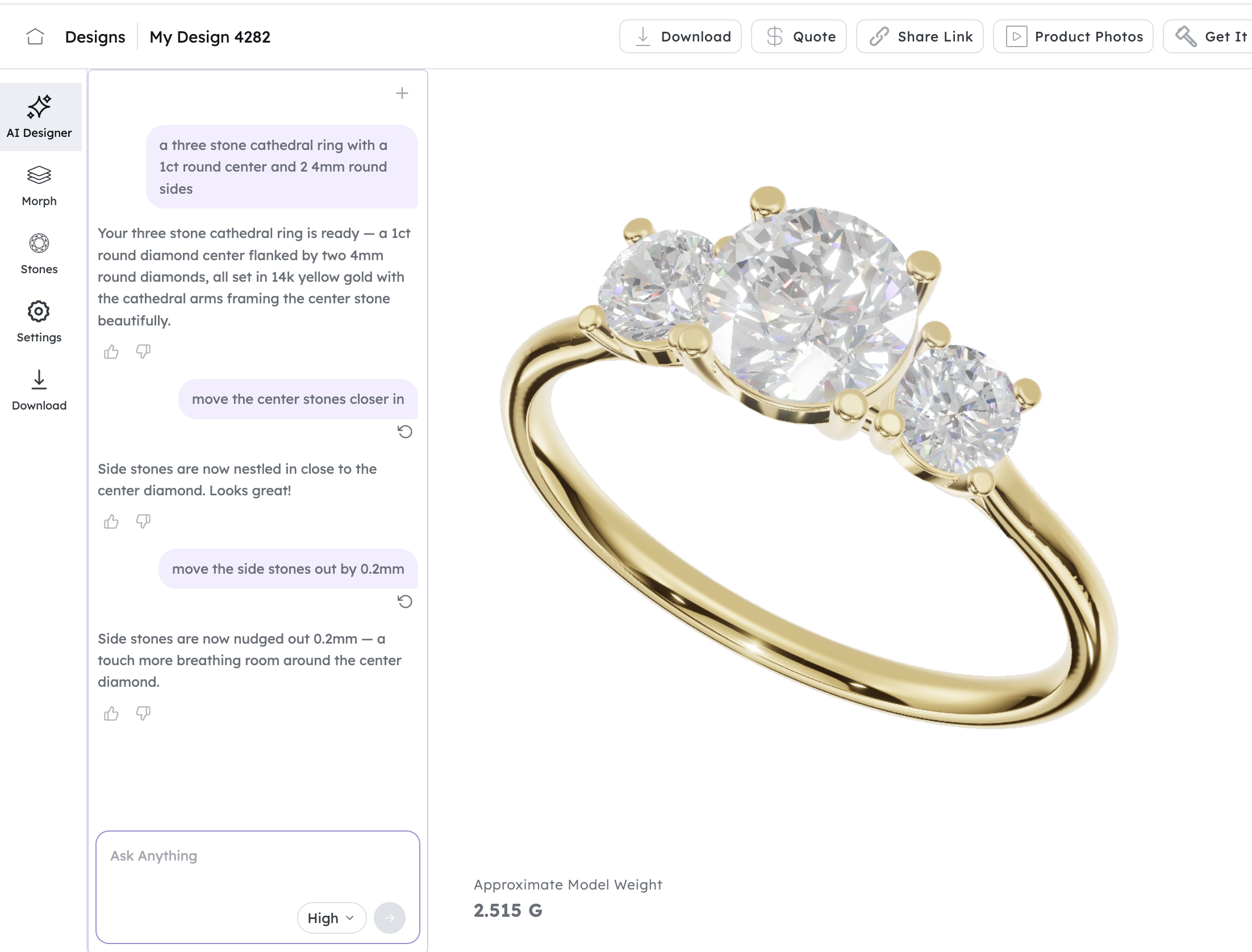
Pencil's AI designer builds real CAD from a conversation. You describe the piece, give measurements if you have them, and refine it.
What comes back is a parametric model you can keep editing.
The same model drives everything else.
The customer sees it in live 3D on your website.
The price is calculated from it and updates with every change.
The production file is ready when they order, with no CAD rebuild.
Lead capture collects the shopper's details as they design, and the Pencil API sends each lead to your CRM.
Pencil is a sales platform as well as a design tool. Lead capture is built into every builder. The API connects your leads and designs to your CRM. A full analytics platform shows how shoppers use your builders.
You do not have to take our word for the CAD. Pencil is free to start, so you can build a ring and inspect it today. Pencil Shop adds ring, pendant and nameplate builders for your website for $199 a month, with a 7-day free trial.
Frequently asked questions
Is Ruby Kinglet CAD software?
It is mainly AI image software with a CAD component. Its site says the CAD engine exports mesh files on the $35 plan and editable 3DM on the $179 plan. We found no demo, sample file or customer example that shows it.
Can you manufacture from a Ruby Kinglet file?
Ruby Kinglet says standard rings, pendants and studs often cast after a thickness check. It also says a bench jeweler should review every file, and that complex pieces may need a CAD jeweler to finish them.
Does Ruby Kinglet show shoppers an exact price?
In its custom design mode, the shopper's design arrives as a quote request. Pencil calculates the exact price from the CAD model and shows it as the shopper designs.
How much does Ruby Kinglet cost?
Personal is $7 a month, Professional is $35 and Studio is $179. CAD files start on the $35 plan, and editable 3DM and the storefront customizers are on the $179 plan.
What is the best alternative to Ruby Kinglet?
For jewelers who make what they sell, Pencil. It is parametric CAD with AI design, exact live pricing and a production file for every order, and you can test it for free.